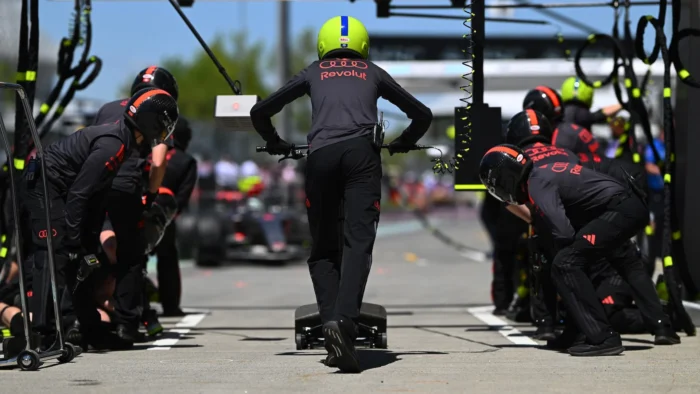

Audi team principal Mattia Binotto has stated the squad’s power unit represents an “obvious gap” to the rest of the F1 competition.
The German manufacturer joined the F1 grid this year for the first time as part of the new cycle of technical regulations, taking over the Sauber outfit while also introducing its own engine.
After scoring points on its debut at the Australian Grand Prix, the team has since hovered around the fringes of the top 10.
However, it has encountered issues with its power unit, particularly during the Miami Grand Prix weekend last time out, leaving Bintto to concede that it is an area it needs to improve.
“When assessing the performance on track, I think the most obvious is the gap we’ve got on the power unit, which again for us is not a surprise, it was expected,” Binotto told media including ApexF1News.
“Being a brand-new engine manufacturer, you may expect such a gap to the best organisation. But here we’ve got plans ahead. It’s not a matter of being desperate.
“On the opposite, I think it’s assessing where we are. It’s a big, huge gap, we believe, but we’ve got a plan of development for the future and we are focused on that.”
Audi currently sits ninth in the constructors’ championship after four rounds but has outlined its ambition to contend for titles by 2030.
Despite the deficit with its power unit, Binotto has been encouraged by its early performance.
“Obviously for us it has been a new start as well as a project, Audi F1 project, from Sauber to Audi. It’s brand-new regulations and I have to say overall we are pleased with what we have achieved so far.
“It’s very easy to make things wrong in F1 and you can see around us other teams have more difficulties.
“So, as a brand-new team, brand-new manufacturer, we are pleased. Pleased doesn’t mean to be satisfied. There is much to come.
“Our ambition is very high. Our long-term ambition is very high and when we look at the performance on track, still there is a big gap to the top competitors, which is not a surprise.
“Top competitors are very strong organisations, well-established organisations, and we know that in order to close that gap there is a lot that needs to be done. What there is? People, team size, infrastructures, capabilities, tools.”